TRENDING NFL Power Rankings Week 9 Waiver Wire Bears beat Seahawks MLB award finalists NBA Power Rankings Story by Story by Canelo vs. Mbilli: 5 things we learned from Canelo Alvarez's big return — and the problem it creates Alan Dawson Uncrowned Tue, November 3, 2026 at 12:33 AM UTC · 9 min read About Our Ads Advertisement Advertisement Advertisement Saul "Canelo" Alvarez returned to boxing this past Saturday to remind the sport that, even at age 36, he not only still has it, but can still use it to thwart any remaining challengers in the super middleweight division .
Christian Mbilli may have walked the WBC world championship to the ring against "Canelo," but it was the Mexican who left Riyadh with the belt , having outpointed Mbilli with relative ease.
Here are five things we learned from the fight — and Saturday's event as a whole .
Mbilli entered the Kingdom Arena with a reputation as a relentless, physically imposing pressure fighter.
An easy interpretation for how ineffective he appeared against "Canelo," when compared to Mbilli's draw with Lester Martinez in 2025 and win over Sergey Derevyenchenko in 2024, could have been that he was affected by the stage, the opponent, or a combination of both.
Compubox data suggests Mbilli tried but landed far fewer punches per round on "Canelo" (10.6 shots on average) than he did on Derevyanchenko (21.5) and Martinez (27.3). And Mbilli's punching accuracy was roughly halved to 17.5%, down from 30.9% (against Derevyanchenko) and 34.7% (against Martinez).
Mbilli threw more jabs per round against Alvarez (29.3) than he did versus Derevyanchenko (25), but fewer power punches (31.1 against 44.6) — consistent with a fighter struggling to get any offense going.
Mbilli's output actually increased in the second half of the "Canelo" fight, from 57.2 punches thrown per round on average in rounds one through six, to 63.5 in rounds seven to 12. His accuracy, though, remained poor — he threw 38 more punches in the final six rounds, landing only one more than he did in the first half despite the added sense of urgency.
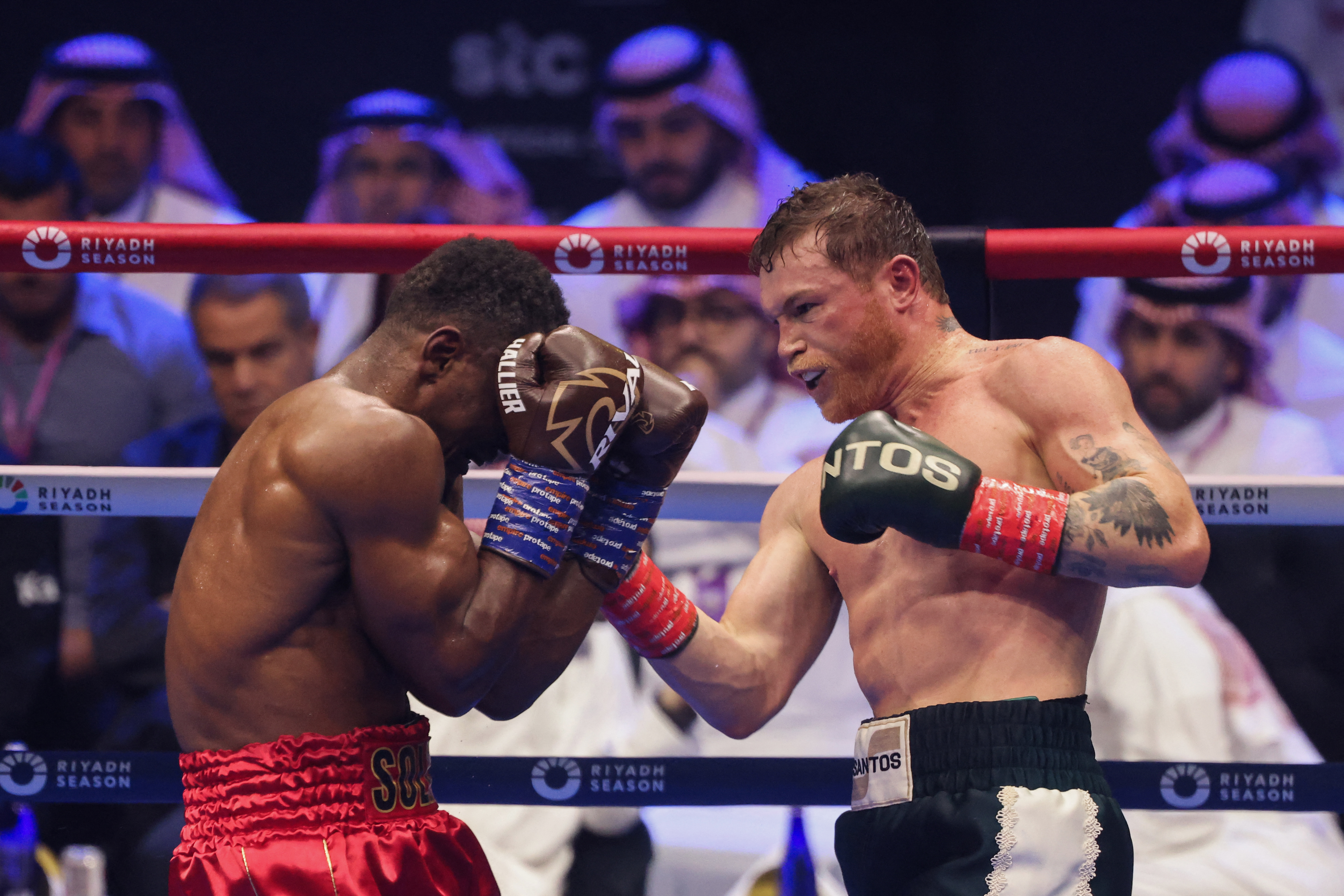
Canelo Alvarez (R) dominated Christian Mbilli for long stretches of their WBC super middleweight world championship bout.
For years, there was a consensus that fighters in and around super middleweight may have paused taking on significant challenges when waiting to play the "Canelo" sweepstakes, only to then freeze on the night if Alvarez agreed to a fight with them. But that wasn't as clear a case with Mbilli, no.
Instead, "Canelo" deserves praise for neutralizing Mbilli's greatest weapon — his unrelenting attack — through the efficacy of his own jab, defensive positioning, and spirit-beating counterpunching.
Alvarez dictated his own pace rather than allow Mbilli to impose his customary high-volume attack, making him increasingly reluctant to initiate exchanges.
He may be removed from the peak of his powers at age 36, but "Canelo" remains a savvy enough veteran to problem-solve in the ring against the rest of his division.
Alvarez's longtime trainer/manager, Eddy Reynoso, is synonymous with his primary fighter's defensive discipline, calculated pressure, and counterpunching abilities.
Yet all those qualities were conspicuously absent from another Reynoso fighter, Jaime Munguia, who competed against Nikita Zon earlier in Saturday's show.
Though Munguia survived a sixth-round scare, he ultimately defeated Zon and retained his WBA super middleweight title on the scorecards through his experience of fighting into the championship rounds.
Munguia remains a high-volume, defensively vulnerable brawler who is reliant on his toughness to survive problems that his reckless aggression seems to create.
In the opening rounds, Zon roughhoused Munguia, disrupted the champ's rhythm and found the openings for his own punches by drawing Munguia into an ugly, stupid, but entertaining contest. Munguia managed to hurt Zon in the fifth but, in the sixth, those roles were reversed — Zon staggered the Mexican with a chin-checking uppercut, and his sustained assault caught the attention of referee Tony Weeks, who appeared close to waving the bout off.
Munguia survived, though. He rallied, and even seemed to hurt Zon before the bell, capping off one of the year's most watchable rounds of action.
From there, Munguia continued a spiteful attack on Zon's body and controlled the second half of the fight against the fading Russian.
He may have won a unanimous decision, but the scores of 117-111 (twice) and 116-112 conceal how close Munguia came to disaster.
The 30-year-old has had the benefit of three camps now under Reynoso's watch. And despite training alongside "Canelo," Munguia's fundamental weaknesses remain at the forefront of his fighting style. He's vulnerable to uppercuts. He gets caught in exchanges. And he struggles with defensive responsibility.
Munguia's next opponent may well make those deficiencies relevant, as the WBA's mandatory challenger is Bektemir Melikuziev, who's expected to fight for Munguia's title early in 2027.
A stronger, disciplined and more experienced fighter could finish the job that Zon couldn't. Whether Melikuziev is that fighter remains to be seen.
Keeping with Munguia for a little longer, yes, he may have the WBA belt, but as "Canelo's" training partner, it makes him an improbable future opponent. That he lost decisively to "Canelo" as recently as 2024 only harms his chances even more.
Reynoso told Ring Magazine earlier this year he prefers Alvarez fighting at 168 pounds, making further moves to other weight classes unlikely, at least for now.
That leaves a super middleweight class full of names who are unheralded, untested, or unfancied.
Super middleweight champs Saul "Canelo" Alvarez and Jaime Munguia are teammates.
Yes, there is Hamzah Sheeraz — the 6-foot-3 British contender who annihilated Edgar Berlanga in 2025 . And his size, reach and power alone could present interesting problems for "Canelo."
But Sheeraz flattered to deceive in his subsequent fight — a majority decision win over Simon Zachenhuber. So it is unclear whether Sheeraz is as hot as he was last year, or if, in 2026, he is a mere simmer.
The most deserving WBC challenger is arguably Lester Martinez who, as the interim champion, has a natural route to Alvarez's newly acquired title. Martinez's international profile is limited though, and despite wins over Immanuwel Aleem (decision) and Luka Plantic (knockout), his split draw in 2025 with Mbilli — a fighter whom "Canelo" romped over — makes it difficult to present himself as a man capable of doing what his previous rival failed to.
That leaves Osleys Iglesias, who is perhaps the most dangerous opponent of all. A 28-year-old southpaw, Iglesias is the IBF super middleweight world champion. He has stopped 15 of his 16 opponents and most recently knocked out previously unbeaten Oliver Zaren in seven rounds on Oct. 8.
He's technically accomplished, powerful, and presents a different challenge from the pressure fighters "Canelo" has repeatedly beaten. Iglesias has explicitly called for a unification fight with "Canelo," but lacks the commercial profile of boxing's bigger names.
Iglesias may be dangerous, Martinez may be deserving, and Sheeraz may have physical advantages, but none present "Canelo" with an immediately obvious blockbuster.
UFC CEO and Zuffa Boxing co-founder Dana White has long lamented boxing's broadcast production. And his old comments about the long, drawn-out nature of the sport's events rang even truer on Saturday, when the Canelo-Mbilli pay-per-view kept cutting to the studio for, at times, needless hour-long segments.
"These guys will do a fight, and then have a f***ing podcast for an hour and thirty minutes before the next f***ing fight comes on," White told reporters in 2024. It's a position he's only reiterated since.
For far too long on Saturday, it felt like a DAZN customer was getting studio analysis for their money, with a sprinkling of combat between the talk shows. We could have moved from one main-card fight to the next, but viewers kept having to endure extended studio discussions, recycled interviews, backstage reporting, promotional packages and generic filler.
And this is not a knock on DAZN's Kate Abdo and Chris Mannix, both of whom are experienced and engaging broadcasters. The issue is with organizers designing these shows and dictating a running order that cannot seem to be deviated from if and when there are knockouts.
It wasn't just Canelo-Mbilli either, as July's Anthony Joshua vs. Kristian Prenga event was also hellishly long when, at 10 fights, it need not have been.
Boxing doesn't even need to look at UFC's pacing to get it right, either. Real American Freestyle and Bare Knuckle Fighting Championship also bang their matchups out one after the other, respecting the time commitment from fans.
All Saturday's bloat did was provide a compelling advertisement for White's most vicious arguments about boxing.
Turki Alalshikh and UFC CEO Dana White do not appear aligned on event pacing.
By the time most, if not all of the fighters, their teams, and the production crew arrived in Riyadh, they may have received the same text message sent to cell phone users in the city on Oct. 29.
"Warning," the message said. "City of Riyadh is under a hostile aerial threat. Please remain calm, stay indoors or in a safe place away from windows and doors, and follow the instructions of Civil Defense."
It was the second one sent that week — fight week.
Official guidance suggested avoiding crowds, large gatherings, and potentially targeted public locations because of the present danger of Houthi-led missile attacks.
The threats had already proven deadly, with Reuters reporting earlier in October that an attack on Riyadh's King Khalid International Airport killed at least 12 people and wounded more than 300. A subsequent attack killed another person and injured nearly a dozen more.
This was an established security risk, not speculative alarmism, with foreign governments around the world advising against non-essential travel to Saudi Arabia.
The contradiction, with a relatively inconsequential sports event proceeding, is absurd. And though the event went off without a disaster, the risk could have been entirely avoidable.
At the start of the Turki Alalshikh era in boxing, there was a suggestion that Riyadh could become a new fight capital.
But ongoing pacing issues on top of reckless event-planning suggests Las Vegas never had anything to worry about.
Source: Sports



0 Comments